
Heart valve disease, which includes both congenital and acquired forms, is an important health problem in different regions of the world. It appears crucial to elucidate the etiology of this disease. Cardiac valve development is a complex process that lead to mature valve leaflets composed of highly organized extracellular matrix (collagens, proteoglycan and elastin) forming of three distinct layers (fibrosa, spongiosa and ventricularis). However, the factors that regulate these matrix components required for the structure and biomechanical properties of the valves are still unknown. Our lab showed that Krox20 (also named Egr2), a zinc finger transcription factor, is essential to control valve homeostasis. Indeed, its deletion results to aortic valve regurgitation associated with significant hyperplasia of the valve leaflets. These defective aortic valves have features of human myxomatous valve disease, including excess of proteoglycan deposition and reduction of collagen fibers, particularly collagens type I and III. Using functional promoter analyses and in vivo experiments, we conclude that Krox20-mediated activation of fibrillar Col1a1 and Col3a1 genes is crucial for normal function of the aortic valve. These results may help to understand the mechanism that lead to valve disease. Odelin et al., 2014
Neural crest cells from pre-otic and post-otic regions make distinct contributions to the arterial valve leaflets. Using genetic fate-mapping analysis of neural crest Krox20-expressing cells we have shown that this cell population makes a large contribution to the borders and the interleaflet triangles of the arterial valves. Moreover, loss of Krox20 function results in hyperplastic aortic valve and partially penetrant bicuspid aortic valve formation. Therefore, our findings unravel a critical role of Krox20 in arterial valve development and reveal that excess of neural crest cells may be associated to bicuspid aortic valve. Odelin et al., 2018
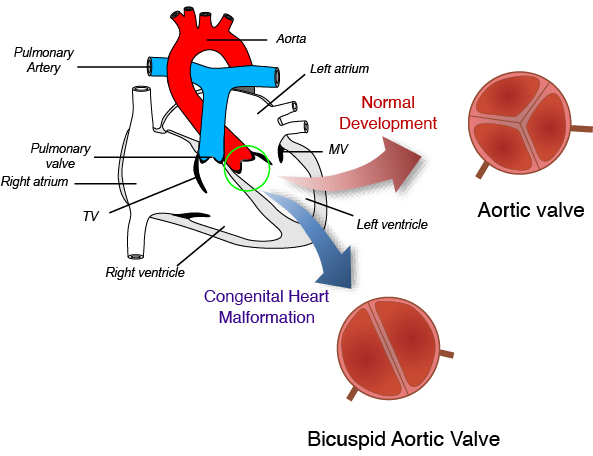
Bicuspid Aortic Valve (or BAV) is the most common cardio-vascular malformation. In BAV, the valve between the left ventricle of the heart and the aorta is composed of two leaflets instead of three in the normal conditional. Initially asymptomatic, BAV can lead to severe complications including aortic stenosis, regurgitation, endocarditis or aortic dissection. Genetic studies have established that BAV is a heritable trait, but only a few gene mutations have been associated to BAV in humans. Using human genetics analysis together with animal models we identified that variants in the poly-histidine repeat motif of HOXA1 and show that its disruption leads to BAV. Odelin et al., 2023
These works were supported by the AFM-Telethon, the FRM and the Fondation Lefoulon-Delalande
